
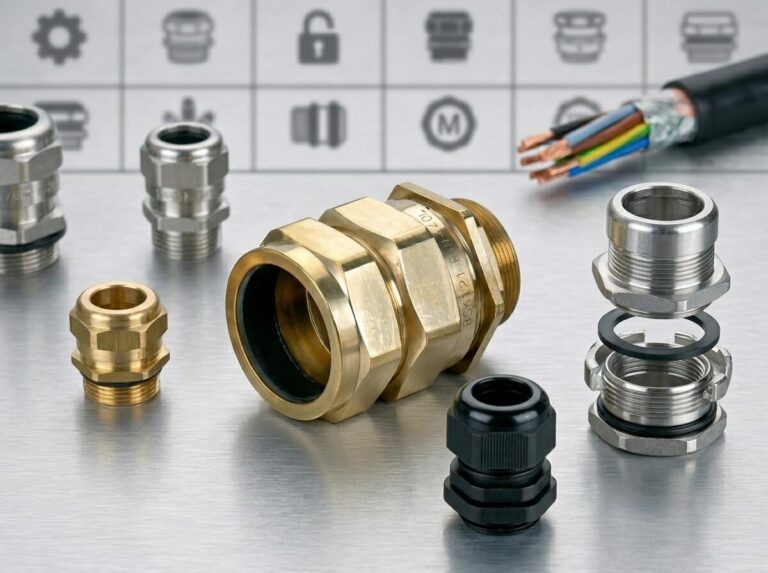
Selecting the correct cable gland is one of the most important parts of safe and reliable cable installation. A properly selected gland ensures sealing, earthing continuity, mechanical retention, weather protection, and long-term durability of the cable system. Wrong gland selection can lead to water ingress, cable damage, poor earthing, or even hazardous failures in industrial environments.
This guide explains how to choose the correct cable gland step by step for industrial, commercial, and outdoor applications, especially for commonly used strip/flat wire armored cables in the Indian market.
Select According to Cable Type & Construction
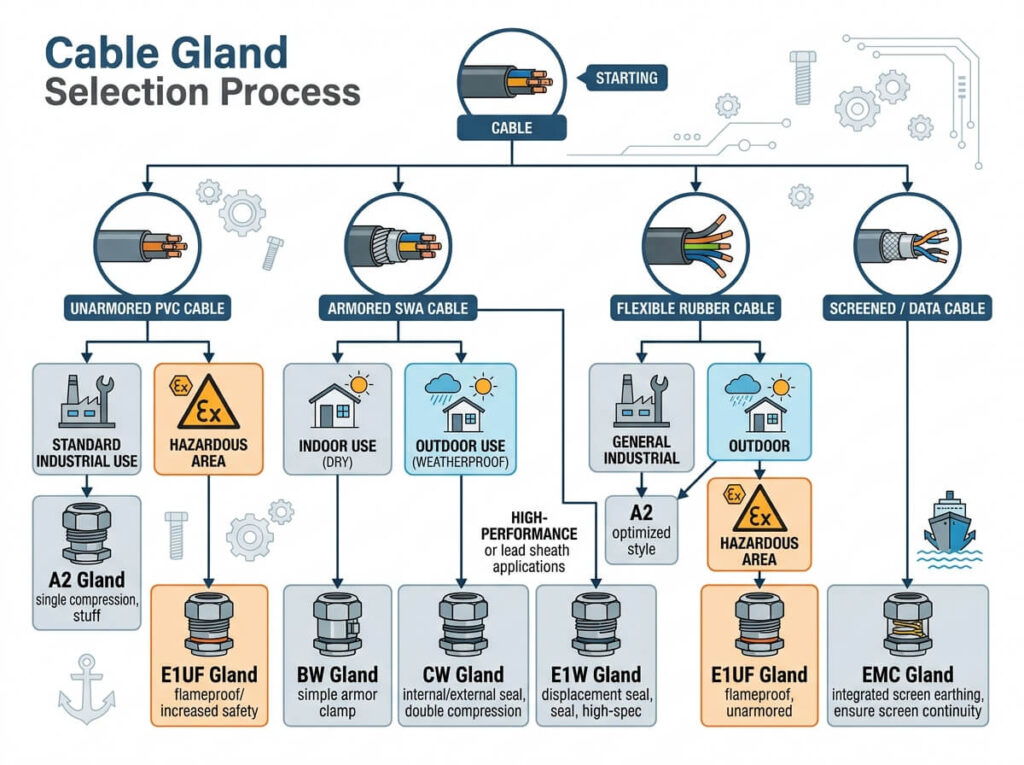
The first and most important step is identifying the cable construction. Different cable types require different gland designs.
A. Unarmored / PVC Cable
For PVC insulated or unarmored cables, standard compression glands are generally used.
Suitable Gland Types
- BW Gland — Indoor dry applications
- A2 / A1 Gland — Outdoor or weatherproof applications
Features
- Simple sealing arrangement
- Provides mechanical grip
- Suitable for control panels and indoor equipment
- Economical solution for standard applications
Typical Applications
- Electrical panels
- Indoor machinery
- Distribution boards
- Instrumentation wiring
Example
3-core 1.5mm² PVC cable used in an indoor control panel with M20 entry:
- Recommended gland: A2 20S Compression Gland
- Protection level: IP54
B. SWA / Armored Cable
Armored cables require glands capable of clamping both the armor and the inner sheath.
Suitable Gland Types
- CW Gland
- E1W Gland
- E1FW Gland
These glands provide:
- Armor clamping
- Earthing continuity
- Double compression sealing
- Better cable retention
Applications
- Industrial installations
- Outdoor feeders
- Heavy-duty machinery
- Hazardous areas
Example
4-core 2.5mm² SWA cable used outdoors with M20 hole:
- Recommended gland: E1W 20S Brass Gland
- Protection: IP66
C. Flexible / Rubber Cable
Flexible cables require wider sealing arrangements because cable movement and bending are common.
Suitable Gland Types
- Dome-type glands
- E1UF Glands
Features
- Wider sealing range
- Better flexibility
- Prevents cable stress
Applications
- Portable equipment
- Welding machines
- Motors
- Temporary power systems
D. Screened / Data Cable
Data and instrumentation cables need protection from electromagnetic interference (EMI).
Suitable Gland Types
- EMC Cable Glands
Features
- 360° shield termination
- Improved EMC performance
- Reduced signal interference
Applications
- CAT6 cables
- Instrumentation systems
- CCTV systems
- Automation equipment
Example
Outdoor CAT6 camera cable:
- Recommended gland: M20 EMC Gland
- Sealing range: 5–10mm
- Protection: IP68
Check Cable Dimensions Carefully
Correct gland sizing is critical for maintaining IP rating and cable safety.
You must measure:
- Overall cable diameter (OD)
- Inner sheath diameter (for armored cable)
Understanding Sealing Range
Each gland size supports a specific cable diameter range.
Example
20S gland sealing range:
- 11.7mm to 15.9mm
The cable OD must fall within this range.
Important Selection Rule
The cable diameter should ideally sit in the middle 60% of the gland sealing range.
Why?
- Too loose → poor sealing, water ingress
- Too tight → cable damage and difficult installation
Correct Practice
If cable OD is 13.5mm and gland range is 11.7–15.9mm:
- Perfect selection
Wrong Practice
If cable OD is 11.8mm or 15.8mm:
- Avoid if possible because sealing performance reduces
Consider Environment & IP Rating
The installation environment determines the gland protection level required
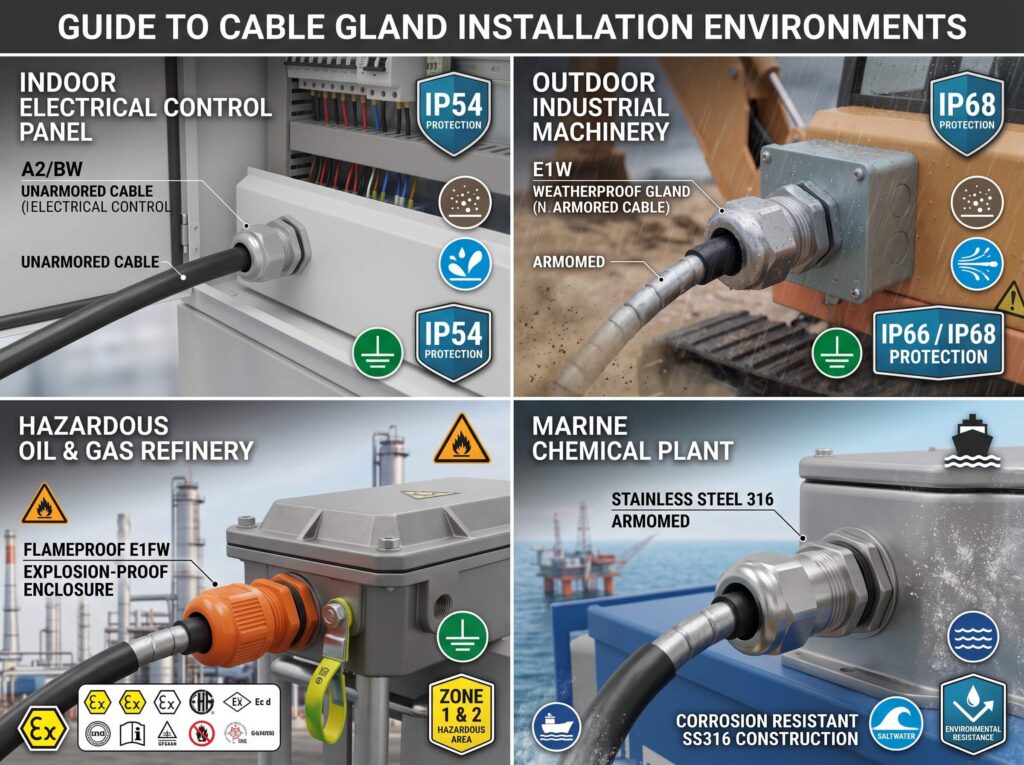
Indoor Dry Areas
Recommended
- IP54 glands
- BW or A2 glands
Suitable Locations
- Indoor panels
- Distribution boards
- Dry industrial rooms
Outdoor or Wet Areas
Outdoor installations require higher ingress protection.
Recommended
- IP66 / IP68 glands
- Neoprene sealing
- A1W or E1W types
Benefits
- Water resistance
- Dust protection
- Long-term outdoor reliability
Suitable Locations
- Outdoor machinery
- Street lighting
- Solar systems
- Pump installations
Hazardous Areas
Hazardous environments require certified flameproof glands.
Recommended
- Ex d / Ex e certified glands
- Brass construction minimum IP66
Suitable Industries
- Oil & gas
- Chemical plants
- Refineries
- Petrochemical facilities
Common Types
- E1FW flameproof glands
- Barrier glands
Corrosive Environments
Chemical exposure or marine conditions require corrosion-resistant materials.
Recommended Materials
- 316 Stainless Steel
- Nickel-Plated Brass
- Nylon for chemical resistance
Suitable Industries
- Marine
- Pharma
- Food processing
- Fertilizer plants
Verify Thread & Entry Size
Cable gland thread size must match the enclosure entry hole.
Common Thread Standards
Metric Threads
Most common in India:
- M20
- M25
- M32
- M40
Other Standards
- PG Threads
- NPT Threads
Always confirm compatibility before installation.
Clearance Hole Check
Ensure:
- Gland fits freely into entry hole
- No forcing or cross-threading
- Sufficient panel thickness support
Locknut & Washer Requirements
For through-hole mounting:
- Use locknut
- Use sealing washer if required
For armored cable:
- Use earth tags for proper grounding continuity
Select Proper Material
Cable gland material affects durability, corrosion resistance, conductivity, and application suitability.
| Material | Recommended Use |
| Brass | General industrial use, good conductivity |
| Nickel-Plated Brass | Damp and corrosive areas |
| 316 Stainless Steel | Marine, food, pharma, chemical plants |
| Nylon | Chemical-resistant lightweight applications |
Brass Cable Glands
Advantages
- Excellent mechanical strength
- Good earthing conductivity
- Cost-effective
Common Usage
- Industrial panels
- Machinery
- General factory wiring
Nickel-Plated Brass
Advantages
- Better corrosion resistance
- Improved surface finish
- Longer outdoor life
Suitable For
- Humid environments
- Outdoor installations
- Coastal areas
Stainless Steel 316
Advantages
- Highest corrosion resistance
- Hygienic
- Long service life
Used In
- Marine applications
- Food industry
- Pharmaceutical plants
Indian Market Preference — HEX Model Series
In the Indian market, strip/flat wire armored cables are commonly used. Therefore, suitable heavy-duty double compression cable glands are preferred for better armor clamping and weather protection.
Recommended HEX Model Series
HDC Series
Double Compression Medium Duty
Suitable for:
- Standard industrial armored cable installations
- Medium-duty environments
HCGW Series
Double Compression Heavy Duty Weatherproof
Suitable for:
- Outdoor applications
- Wet environments
- Heavy-duty industrial areas
Features:
- Better weather sealing
- Higher mechanical strength
- Improved IP protection
HCGF Series
Double Compression Heavy Duty Flameproof
Suitable for:
- Hazardous locations
- Chemical industries
- Oil & gas sectors
Features:
- Flameproof certified construction
- Hazardous area safety
- Heavy-duty armor clamping
Quick Selection Examples
Example 1
- Cable
- 4-core 2.5mm² SWA cable
Application :Outdoor installation with M20 entry
Recommended
- E1W 20S Brass Gland
- IP66 protection
Example 2
Cable
3-core 1.5mm² PVC cable
Application:Indoor control panel
Recommended
- A2 20S Compression Gland
- IP54 protection
Example 3
- Cable
- CAT6 outdoor camera cable
Application
Outdoor surveillance system
Recommended
- M20 EMC Gland
- IP68 protection
- 5–10mm sealing range
Common Mistakes to Avoid
1. Using BW Gland on Armored Cable
BW glands are not suitable for proper armor clamping in many armored applications.
Result
- Poor earthing
- Weak mechanical grip
- Unsafe installation
2. Wrong Gland Size Selection
Too Loose
- Water ingress
- Dust entry
- Loss of IP rating
Too Tight
- Cable damage
- Difficult assembly
- Seal deformation
3. Forgetting Shroud & Earth Tag
For SWA armored cable installations:
- Use earth tags for grounding
- Use PVC shrouds for protection against moisture and corrosion
Final Conclusion
Choosing the correct cable gland is not only about matching the cable size. A proper selection must consider:
Cable construction
- Cable diameter
- Environmental conditions
- IP protection
- Thread compatibility
- Material suitability
Using the correct gland improves:
- Safety
- Equipment life
- Waterproofing
- Earthing reliability
- Mechanical strength
For Indian industrial applications using strip or flat wire armored cables, heavy-duty double compression glands such as HEX HDC, HCGW, and HCGF series provide reliable and durable performance across indoor, outdoor, and hazardous environments.
