
Mechanics, Standards & Safety
A comprehensive technical reference for engineers, quality assurance professionals, and electrical contractors.
The Critical Link in Electrical Continuity
While complex distribution board protection systems often get the spotlight, the fundamental safety of any electrical network relies on its most basic connections. A split bolt connector is a seemingly simple device, yet it carries an enormous responsibility: maintaining absolute electrical continuity under fluctuating thermal, mechanical, and environmental stresses.
Whether used for splicing heavy-duty power lines or ensuring the integrity of critical grounding systems, a failing split bolt can lead to catastrophic arcing, equipment damage, or loss of life. Modern electrical loads demand flawless execution. The financial and operational consequences of a single loose connection can run into millions.
This guide covers the mechanics of compression, the materials involved, the international standards that dictate their performance, and how to specify the exact connector for your application.
The Mechanics of a Split Bolt Connection
To achieve a connection that lasts decades, you must understand the mechanical forces at play when two conductors are compressed together. It is not merely about holding wires in place; it is about creating a cold-welded union.
Compressive Force and Cold Flow
When the nut of a split bolt is torqued down, it exerts immense pressure on the enclosed conductors. As the pressure increases, the localized grain structure in the copper conductors begins to deform. This deformation breaks down surface oxides and forces the metal surfaces into intimate contact, creating a microscopic cold-weld that minimizes electrical resistance.
Thermal Cycling
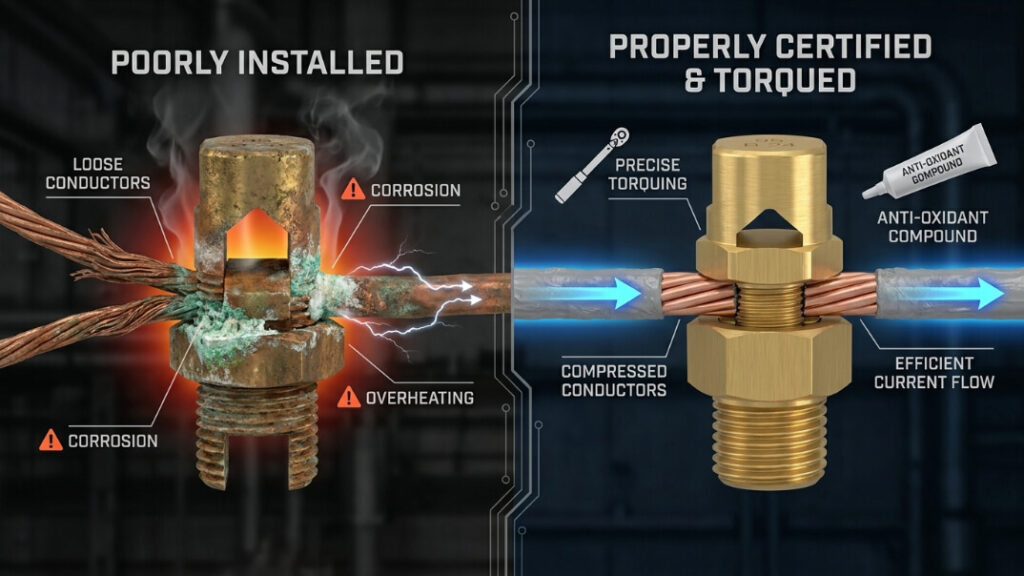
Electrical conductors heat up when carrying current and cool down when the load drops. This thermal cycling causes materials to expand and contract. If the split bolt material does not possess the correct tensile strength and elasticity, this constant movement will gradually loosen the connection, increasing resistance, which in turn generates more heat—a dangerous cycle known as thermal runaway.
Galvanic Corrosion
When dissimilar metals (such as copper and aluminum) are brought into contact in the presence of an electrolyte (like atmospheric moisture), a galvanic cell is formed. The less noble metal will rapidly corrode. This is why material selection and the use of separators or dual-rated connectors are non-negotiable when mixing conductor types.
The Three Pillars of a Reliable Connection
A split bolt is not just a piece of hardware; it is an engineered compression system comprising three interdependent components. Get any one component wrong, and the entire connection is compromised.
Pillar 1 — The Main Body (The Housing)
The U-shaped body must be manufactured from a high-strength material, typically high-copper alloys or specialized brass, depending on the application. It must possess high tensile strength to withstand the required installation torque without snapping or deforming over time.
Pillar 2 — The Nut (The Force Multiplier)
The nut provides the mechanical advantage required to compress the conductors. The threading must be precision-machined. Poorly sheared threads or low-quality grain structures in the metal will cause the nut to bind or strip before the proper compression force is achieved on the conductors inside.
Pillar 3 — The Pressure Bar (The Equalizer)
Many split bolts, especially those designed for dissimilar metals, include a pressure bar or spacer. This component distributes compressive force evenly across the conductors and acts as a physical barrier between dissimilar metals, preventing galvanic corrosion.
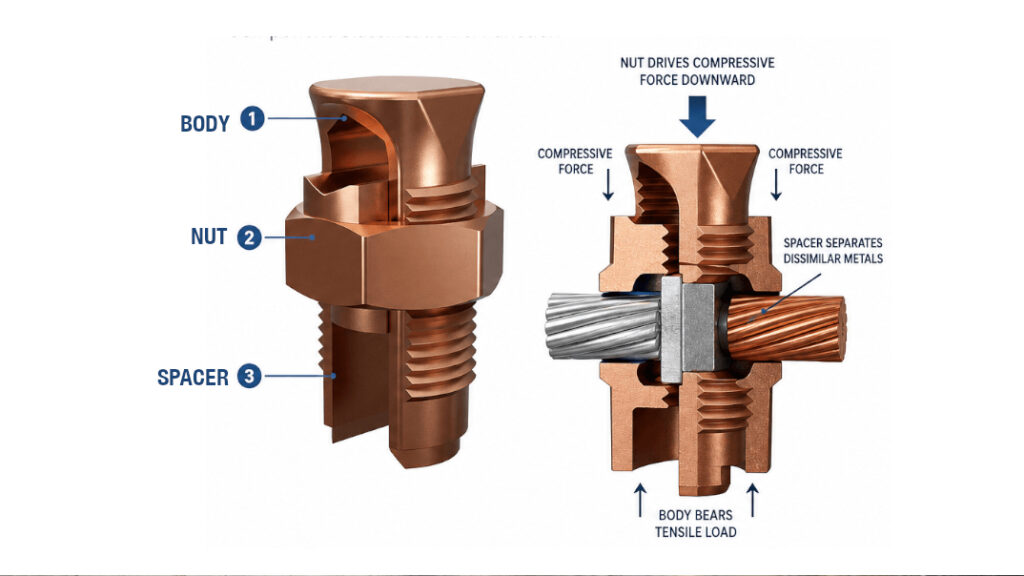
| Component | Primary Material | Key Function |
| Body | High-Strength Copper Alloy | Contains the conductors and bears the primary tensile load. |
| Nut | Copper Alloy / Silicon Bronze | Drives the compressive force downward without stripping. |
| Spacer | Tin-Plated Copper | Separates dissimilar metals and distributes pressure evenly. |
International Standards Decoded
A split bolt connector is only as reliable as the testing standards it meets. In the realm of Quality Assurance, rigorous adherence to international standards is the only way to guarantee performance.
UL 486A-486B: Wire Connectors
This is the primary standard for wire connectors and soldering lugs for use with copper conductors. It outlines the stringent mechanical pull-out tests and static heating (temperature rise) tests that a split bolt must survive to ensure it will not fail under load.
UL 467: Grounding and Bonding Equipment
When split bolts are used in grounding systems—connecting grounding conductors to earth electrodes or bonding structural steel—they must comply with UL 467. This standard tests the connector’s ability to handle massive, short-duration fault currents (like a lightning strike) without melting or releasing the conductor.
Quality Assurance Directive: Maintaining professional transparency in product specifications is vital. It is a strict compliance rule that the UL mark must never be used with non-UL products on any advertising material, packaging, or technical documentation. Misrepresentation invalidates safety claims and introduces severe liability.
Common Myths vs. Reality
Misconceptions about electrical connections often lead to installation failures. Here are the most common myths encountered in the field.
| Common Myth | The Reality |
| “Hand-tightening with a wrench is enough.” | Torque wrenches are mandatory. Over-tightening crushes the conductor; under-tightening causes high-resistance heating. |
| “Any split bolt can connect aluminum to copper.” | Only dual-rated (AL-CU) split bolts with a separating spacer and applied anti-oxidant compound can safely mix these metals. |
| “Reusing a split bolt is perfectly safe.” | Once torqued, the threads and body undergo stress. Reusing them compromises the tensile integrity of the connection. |
| “They don’t need insulation.” | Unless used in a bare grounding array, all split bolts must be heavily insulated with rubber splicing tape and vinyl electrical tape to prevent arcing and protect against moisture. |
Installation & Quality Assurance
A correctly specified split bolt that is poorly installed will fail. Installation quality is as critical as the component design itself.
Conductor Preparation
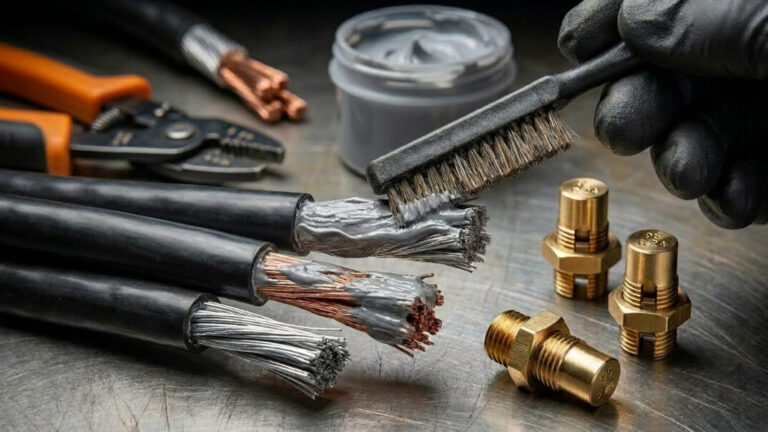
Conductors must be stripped carefully to avoid nicking the wire strands. For older copper or any aluminum conductors, the surface must be wire-brushed to remove oxidation immediately before insertion.
The Application of Anti-Oxidant
Particularly when aluminum is involved, a specialized anti-oxidant joint compound must be applied to the conductors. This paste prevents oxygen and moisture from reaching the freshly brushed metal, halting the formation of high-resistance oxides.
Precision Torquing
Every split bolt manufacturer provides a specific torque value based on the bolt size and conductor gauge.
- Installers must use a calibrated torque wrench.
- This ensures the grain structure of the conductor is optimally compressed without stressing the bolt beyond its yield point.
7. How to Specify the Right Split Bolt
Selecting the correct connector requires strict attention to the operational environment and the conductors being joined.
- Determine the Conductor Material: Are you joining Copper to Copper (Cu-Cu), Aluminum to Aluminum (Al-Al), or Copper to Aluminum (Cu-Al)?
- Verify the Sizing Range: Split bolts are rated for a range of wire gauges (e.g., #8 AWG to #2 AWG or 6 mm2, 10 mm2, 16 mm2 etc.). Ensure both the main and tap conductors fall within the approved range of the specific bolt.
- Check the Application: Is this for power transmission, or is it part of an exothermic-joint alternative in a grounding grid? Grounding requires UL 467 compliance.
- Confirm the Plating: If exposed to harsh environments, tin-plated copper alloys offer superior corrosion resistance compared to bare brass or copper.
8. Conclusion: The Integrity of the Network
The most important takeaway is that electrical reliability relies entirely on the integrity of its physical connections. A split bolt is not an afterthought; it is a critical engineered junction.
A fully compliant connection—where the connector is manufactured from high-grade alloys, tested to UL standards, and installed with exact torque—is one of the most cost-effective ways to ensure system stability. The cost of a premium split bolt is negligible. The cost of a burnt-out distribution board, a failed grounding system, or a halted production line routinely exceeds it by orders of magnitude. Ensure your specifications are exact, your components are certified, and your installation is flawless.
