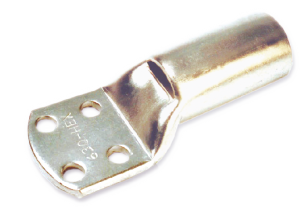
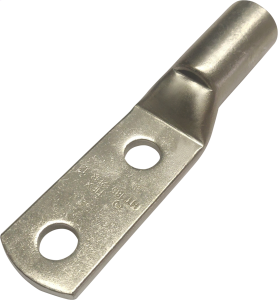
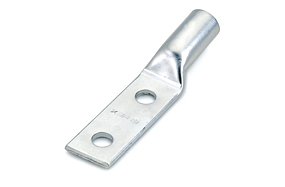
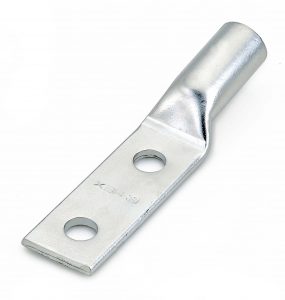
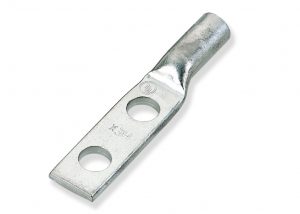
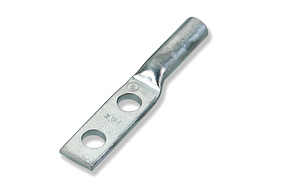
A single-bolt lug connection is adequate for the majority of power cable terminations. But at the high end of the current spectrum — main incomer cables, transformer LV busbar connections, generator output terminals — a single bolt is not enough. The palm area is too small to distribute the clamping force uniformly, the torque capacity of one bolt may be insufficient for the connector’s pull-out and shear requirements, and thermal cycling over the installation’s lifetime will progressively relax the joint.
Multi-hole lugs address all three problems. HEX Worldwide manufactures two-hole and four-hole copper cable terminal ends in standard and economy ranges, engineered for the demanding mechanical and thermal environments of high-current power distribution installations.
Two Hole vs Four Hole vs Single Hole: Selecting the Right Configuration
Criteria
Single Hole
Two Hole
Four Hole
Conductor range typical
1.5 – 300 mm²
25 – 400 mm²
70 – 630 mm²
Clamping force
Single bolt
Double bolt
Four-bolt
Mechanical stability
Adequate for standard use
Good — prevents rocking under vibration
Excellent — no rocking, highest rigidity
Contact resistance
Standard
Lower — larger contact area
Lowest — maximum contact area
Thermal cycling resistance
Adequate
Better
Best
Typical applications
General LV panel wiring, motor feeders
Distribution board busbars, transformer connections
Main incomers, generator terminals, HV switchgear LV connections
Torque requirement
Standard (per bolt size)
Per bolt size × 2 bolts
Per bolt size × 4 bolts
General rule of thumb: For conductors above 150 mm² connecting to copper busbars in switchgear or transformer terminals, specify at minimum a two-hole lug. For conductors above 300 mm² or at any connection where a joint failure would have safety or supply-critical consequences, specify four-hole.
Applications
LV Main Switchboard Incomer Connections The main incomer cable — typically 185 mm² – 630 mm² XLPE copper or aluminium — connects the transformer LV bushing to the main incomer circuit breaker (MCCB or ACB) in the LV switchboard. This connection sees the full fault level of the transformer during a fault, and must maintain mechanical integrity at the short-circuit peak current. Four-hole lugs are the correct specification here.
Distribution Transformer LV Busbars The four bolted LV bushing pads on a 200 kVA – 2500 kVA distribution transformer accept the copper feeder cables that supply the LV switchboard. The bushing pad pattern varies by transformer manufacturer — confirm the pad dimensions and bolt pitch before ordering. Custom palm configurations are available from HEX for non-standard transformer bushing layouts.
Generator and Alternator Output Terminals Diesel generator output terminals connect to the main ATS (automatic transfer switch) or main distribution board via large conductor cables. Generator vibration during operation makes four-hole terminations the preferred specification for durability.
Bus Section and Bus Coupler Connections In LV switchboards with bus sectionalisation (split bus, bus coupler), the bus coupler cable connections are high-current, high-mechanical-stress joints. Multi-hole lugs prevent palm rocking under the thermal and electromagnetic forces that act on main bus connections during fault conditions.
Industrial MCC Main Incomer Motor control centre (MCC) main incomer connections from the supply transformer or main distribution board to the MCC busbar chamber are frequently four-hole connections at 300 mm² and above.
Tinned Variants for Humid & Corrosive Environments
Both two-hole and four-hole copper lugs are available with electro-tinned finish for installations in coastal, marine, high-humidity, or chemically aggressive environments. Tinned multi-hole lugs are particularly important in:
Coastal substations and marine distribution boards
Chemical plant and offshore platform electrical systems
Outdoor generator and transformer enclosures
Frequently Asked Questions
What bolt torque should be applied to two-hole and four-hole lug connections?
Torque requirements depend on bolt size, bolt material, and the busbar contact surface. As a general guide, M10 stainless or zinc-plated steel bolts at a copper-to-copper joint require approximately 25–30 Nm; M12 bolts require 40–50 Nm. Always refer to the switchgear or transformer manufacturer’s torque specification for the terminal in question, and use a calibrated torque wrench. Under-torqued connections relax under thermal cycling and increase contact resistance over time.
Can custom hole pitch be supplied for non-standard transformer bushing pads?
Yes. HEX manufactures custom palm configurations for non-standard bolt pitch patterns on request. Provide the bushing pad dimensions (hole diameter, pitch centres, palm width) and the conductor cross-section, and our technical team will confirm feasibility and pricing. Minimum order quantities apply for custom configurations.
Do two-hole lugs require special crimping tooling compared to single-hole lugs?
No. The crimping operation acts on the barrel, which is identical in geometry to a standard single-hole lug of the same conductor size. The same hydraulic or ratchet crimping tool and die set used for single-hole lugs applies. The multi-hole palm is a forming difference, not a crimping difference.
Are multi-hole lugs available in aluminium for aluminium conductors?
Yes — two-hole aluminium compression lugs are available for aluminium conductor applications. For AL-CU busbar connections (aluminium conductors to copper busbar terminals), bimetallic two-hole lugs with aluminium barrel and copper palm are the correct specification. Contact our sales team for details.
What is the difference between standard and economy range multi-hole lugs?
The standard range is manufactured to full IS 8309 dimensional and material specifications with available test certification. The economy range uses optimised material quantities for cost reduction, and certification documentation is not available. For safety-critical, high-fault-level, or third-party-inspected project applications, always specify standard range.