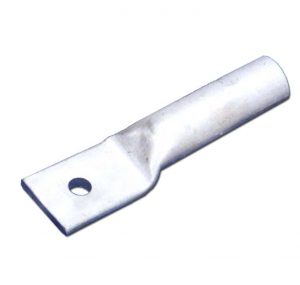
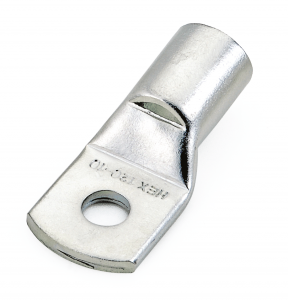
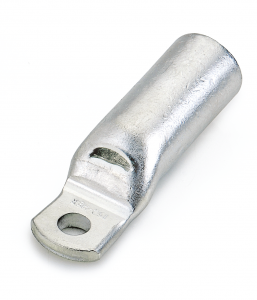
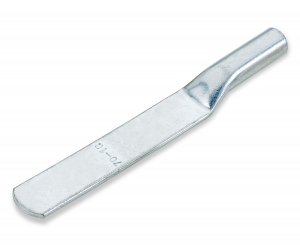
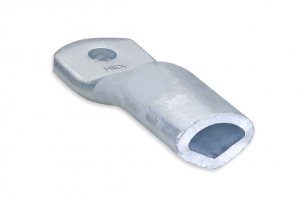
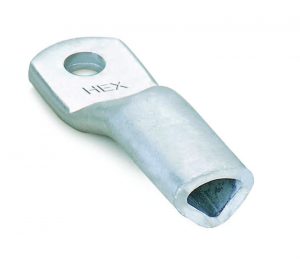
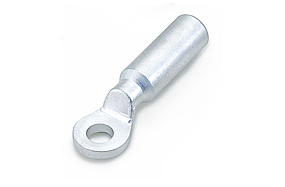
Aluminium conductors dominate high-cross-section power cable installations — overhead distribution lines, transformer secondary feeders, industrial feeder cables above 150 mm², and large XLPE cables — primarily because aluminium delivers acceptable conductivity at a fraction of the weight and cost of equivalent copper. Terminating those conductors correctly demands aluminium-specific lugs: a direct copper lug on an aluminium conductor is not a shortcut, it is a fault waiting to happen.
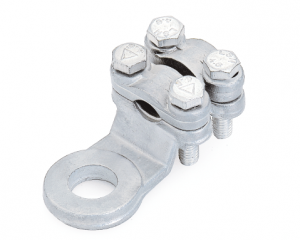
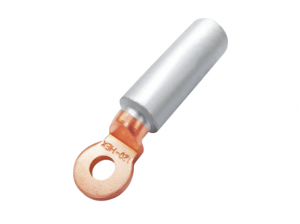
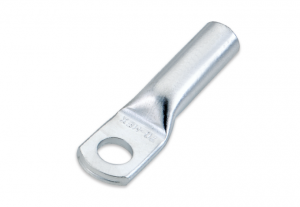
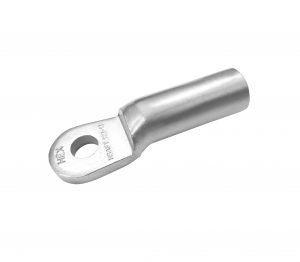
HEX Worldwide manufactures compression type aluminium cable lugs and bimetallic AL-CU transition lugs engineered for the Indian power distribution environment — built to IS 5082 | IEC 61238-1 and supplied to transformer manufacturers, distribution contractors, and EPC companies across India and export markets.
There are two distinct reasons why correct lug selection for aluminium conductors is non-negotiable in engineering practice:
1. Galvanic Corrosion at Dissimilar Metal Joints Aluminium and copper have significantly different electrochemical potentials. When they are in direct metallic contact in the presence of an electrolyte (condensation, humidity, industrial atmosphere), a galvanic cell forms. Aluminium, being the more active metal, becomes the anode and corrodes preferentially. The corrosion product — aluminium oxide — is an electrical insulator. The result is a progressively increasing contact resistance at the joint, localised heating under load, and ultimately joint failure. At fault current levels, a compromised joint can become a fire initiation point.
Bimetallic lugs eliminate this failure mode by providing a factory-controlled AL-CU interface that is sealed, stable, and characterised for contact resistance.
2. Aluminium Oxide Layer Aluminium forms a hard, insulating oxide layer on its surface almost instantaneously on exposure to air. This oxide layer, if not removed or penetrated, will increase contact resistance at any joint. Our aluminium lug barrels are supplied with a factory-applied oxide inhibitor compound (petroleum-based joint compound) that penetrates and disrupts the oxide layer during compression crimping, ensuring metallic contact between conductor strands and lug barrel wall.
Never terminate an aluminium conductor into a copper lug without a bimetallic interface. This is an engineering requirement, not a preference.
Applications
Distribution Transformers LV secondary feeder cable terminations on 11 kV / 433 V distribution transformers, where large cross-section XLPE cables (95 mm² – 400 mm²) connect transformer LV bushings to LV switchboards. Bimetallic lugs are mandatory here — the transformer bushings are copper, and the incoming cables are typically aluminium.
11 kV Underground Cable Networks Aluminium-core XLPE cables for underground urban distribution networks (66 kV and below) require compression aluminium lugs at termination kits and straight-through joints.
Overhead Line to Underground Cable Transitions Junction points between overhead aluminium conductors and underground XLPE feeders require bimetallic lugs at the transition joint.
Industrial Power Distribution Heavy feeder cables (185 mm² – 630 mm²) from utility intake substations to factory HV/LV substations are often aluminium-core for cost and weight reasons, requiring aluminium compression lugs at both the substation end and the MCC incomer.
Renewable Energy Collector Systems Wind farm collector cable systems and large utility-scale solar plant AC collection networks use aluminium-core MV cables where bimetallic lugs connect to copper switchgear terminals.
Frequently Asked Questions
Why do aluminium lugs require a different crimping tool than copper lugs?
Aluminium is significantly softer than copper. Over-crimping an aluminium lug — applying the force calibrated for a copper lug of the same nominal size — will deform the barrel to the point of strand damage or lug failure. Compression tooling for aluminium lugs uses lower-force dies calibrated for the aluminium alloy hardness. Always use the die set specified for aluminium lugs and verify the tool calibration date before use on site.
What is the shelf life of the oxide inhibitor compound in factory-supplied aluminium lugs?
Properly stored (sealed caps, dry conditions, away from direct sunlight), factory-applied oxide inhibitor compound retains its effectiveness for 18–24 months. Check the manufacturing date on the box before installation. Do not use aluminium lugs with dried or contaminated compound.
Can bimetallic lugs be used for both indoor and outdoor installations?
Yes, with appropriate surface protection. For outdoor installations or humid environments, the tinned copper palm surface of bimetallic lugs is recommended as standard. The friction-weld AL-CU interface should be protected from direct water ingress with appropriate sealing tape or heat-shrink sealing after installation. Contact our technical team for outdoor installation guidelines.
Are HEX aluminium lugs compatible with XLPE cables?
Yes. Our compression aluminium lugs are compatible with aluminium-core XLPE cables across the full conductor range (16 mm² – 630 mm²). For cable termination kits, the lug is a component of the complete termination system — ensure the lug dimensions are aligned with the kit specification from your termination kit supplier.
Do you supply aluminium lugs for medium voltage (MV) applications?
Our standard aluminium lugs are rated for LV applications (up to 1 kV as a terminal end component). For MV cable joints and terminations, the lug is part of a complete MV termination kit where the lug dimensions and electrical clearances are specified by the kit manufacturer. Contact us for MV application technical support.